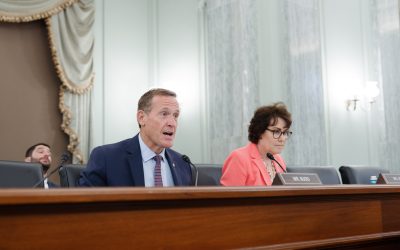


Washington, D.C. — Today, U.S. Senator Ted Budd (R-N.C.), member of the Senate Commerce, Science, and Transportation Committee, released the following statement after his Supersonic Aviation Modernization (SAM) Act received bipartisan support and passed out of the committee. The bill is now headed to the Senate floor.
“If we want to maintain America’s global leadership in technological innovation, we must lift the outdated ban on civil supersonic flight. The SAM Act would unlock the potential for the U.S. to defeat China in the race to develop the next generation of supersonic aircraft. I am grateful to my colleagues on the Senate Commerce Committee for advancing my legislation to the Senate floor, and I commend President Trump and Secretary Duffy for their efforts to reduce regulations that have limited civil supersonic flight. Congress has the ability, by passing the SAM Act, to ensure the supersonic industry will not face government headwinds into the future,” said Senator Budd.
Joining Senator Budd as cosponsors of this legislation are Senators Thom Tillis (R-N.C.), Mike Lee (R-Utah), Tim Sheehy (R-Mont.), John Hickenlooper (D-Colo.), and Michael Bennet (D-Colo.).
“Outdated regulations are keeping America’s supersonic innovation grounded while China soars full speed ahead. Our national security depends on cutting outdated red tape around supersonic flight – we need to deregulate so Americans can innovate. The Supersonic Aviation Modernization Act will lift unnecessary restrictions around supersonic flight to unleash American dominance. I’m pleased to see it marked up in committee and look forward to voting for it on the Senate floor,” said Senator Lee.
“We can’t continue to hinder innovation due to outdated restrictions. It’s common sense: if no sonic boom reaches the ground, supersonic flight should be allowed. The Supersonic Aviation Modernization (SAM) Act gets rid of burdensome red tape so the United States can continue leading the way in aviation on the world stage, while maintaining protections for public safety and property on the ground. I’m proud to support this legislation and am glad to see it advance through the Senate Commerce Committee,” said Senator Sheehy.
“In Colorado we know all about the power of aerospace innovation. Supersonic flight is yet another way to move us into the future. Making air travel faster while preserving public safety is a win-win,” said Senator Hickenlooper.
“The SAM Act will revolutionize air travel, bolster Colorado’s economy, and promote innovation. I am glad to see this legislation passed out of committee as we work to secure continued U.S. leadership at the forefront of civil aviation,” said Senator Bennet.
“We’re grateful for Senator Budd’s historic work leading a bipartisan coalition for supersonic passenger flight for all in the US,” said Blake Scholl, Founder and CEO, Boom Supersonic.
BACKGROUND
In June 2025, Senator Budd first introduced the SAM Act, which would require the Federal Aviation Administration (FAA) Administrator to issue regulations to legalize civil supersonic flight in the United States. The legislation would allow operators to fly aircraft at supersonic speeds within the National Airspace System, provided that no sonic boom reaches the ground. Read more HERE.
In June 2025, President Trump also signed Executive Order 14304, Leading the World in Supersonic Flight, calling on the FAA to secure aviation safety agreements with foreign aviation authorities to ensure the safe international operation of supersonic aircraft.
In June 2026, U.S. Secretary of Transportation Sean Duffy announced a proposed rule to set a noise-based certification for supersonic aircraft. Additionally, Secretary Duffy announced that the FAA plans to propose another rule later this year to establish landing and takeoff noise standards for supersonic aircraft.
If signed into law, Senator Budd’s SAM Act would codify the Trump Administration’s efforts to lift regulations limiting American aerospace innovation and supersonic flight over land.
###