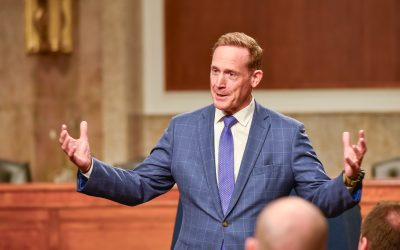


Washington, D.C. — Today, U.S. Senator Ted Budd (R-N.C.) testified before the Senate Appropriations Committee to highlight how additional disaster relief funding would benefit Western North Carolina as the region continues to rebuild twenty-one months after Hurricane Helene. Senator Budd was invited to appear at the hearing, which was convened to review President Trump’s Supplemental Funding Request. Last month, Senator Budd vowed that he would not support any supplemental appropriations package that does not include additional funding for Western North Carolina.
Here are Senator Budd’s remarks as prepared for delivery:
“Chair Collins, Vice Chair Murray, and Members of the Committee: Thank you for the opportunity to testify this afternoon to provide a voice for the people in Western North Carolina.
“More than 21 months ago, Hurricane Helene unleashed an unprecedented amount of rainfall upon the Blue Ridge Mountains, causing severe flooding and devastating landslides. The storm left behind tens of billions in damage.
“In December 2024, Congress responded by approving a disaster supplemental that provided billions of dollars to Western North Carolina recovery. Additionally, North Carolina’s state government stepped up by committing roughly $2.4 billion in state appropriations and redirecting more than $2 billion from state agencies for reconstruction.
“But the Blue Ridge Mountains’ challenging terrain has made it uniquely difficult for federal programs to operate, resulting in delays and inefficiencies. And there is still work to be done.
“Too many projects in Western North Carolina have stalled due to insufficient funding, or because of financial shortfalls from expensive debris removal and rebuilding efforts.
“I greatly appreciate that President Trump and Secretary Mullin have empowered FEMA to more rapidly reimburse the state & local governments for public assistance projects. However, FEMA is only one part of the equation. The Environmental Protection Agency, Department of Housing and Urban Development, and other federal agencies play a key role in disaster recovery, and much of the existing disaster funding for those agencies has already been largely allocated.
“When I visit Western North Carolina, I still see the impacts the delays in recovery have caused. Debris still clogs waterways. Facilities that provide drinking water and manage wastewater have yet to be rebuilt. Most concerning, some homeowners are paying mortgages on properties that are still unlivable or yet to be rebuilt.
“Towns have been forced to embrace expensive short-term stopgap solutions just to carry out their most basic functions for their residents.
“In the small town of Beech Mountain, there is no long-term water supply. The dam and water treatment plant were heavily damaged, forcing the town out of compliance with state safety standards. As a result, the state could be fining Beech Mountain $25,000 per day.
“Major repairs are needed so that the water treatment plant can function long-term. If funded, this process will take at least a year, and require significant diversion of utilities and/or daily water trucks, just so hundreds of residents will have clean drinking water during construction. Three years is too long to wait after a disaster—we can’t delay any longer.
“Tourism, the lifeblood of much of Western North Carolina, has begun to rebound, but there are still far too many areas that are unable to accommodate the travelers they once welcomed.
“But I want to highlight a few examples of success stories to show how ample funding from the last disaster supplemental, paired with exceptional planning and project execution, made an immediate impact on our mountain communities.
“Last July, key portions of the Blue Ridge Parkway reopened after 57 landslides struck 200 miles of the parkway.
“This Memorial Day weekend, Lake Lure reopened to the public after an incredible debris removal and refilling project.
“I want to be clear that I fully support President Trump’s request to replenish our munitions stockpile and strengthen our military. I am also appreciative of his efforts to provide economic assistance to farmers impacted by disasters and unfair trade practices.
“However, to address the long-term recovery needs of Western North Carolina, more federal funds are needed.
“Every time I’m in Western North Carolina, people ask me to make sure that they’re not forgotten. This is Congress’s chance to remind them that we’re serious about helping them get back on their feet.
“I am deeply grateful to the Members of the Committee for holding this hearing. I look forward to continuing to work with you all as this process continues.”
###