

“The people of the Appalachian Mountains are leaning on faith, hope, & determination to carry us through the aftermath of this storm.”
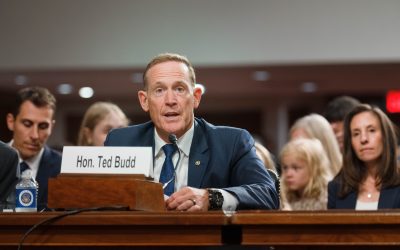
Washington, D.C. — To commemorate the first anniversary of Hurricane Helene and its impact on Western North Carolina, U.S. Senator Ted Budd (R-N.C.) took to the Senate floor to reflect on the lives lost, heroism displayed, and critical recovery efforts that occurred during and after this devastating storm.
Watch Sen. Budd’s speech in its entirety HERE
FULL TRANSCRIPT:
“I rise today in remembrance of the one-year anniversary of Hurricane Helene, a disaster of unprecedented magnitude that devastated North Carolina’s Appalachian Mountains.
“On the evening of September 26, 2024, this historic storm struck the Blue Ridge Mountains, leaving a trail of devastation in its wake—putting the livelihoods of thousands of North Carolinians on hold and shattering many communities.
“As we approach this solemn anniversary, I want to reflect on the lives Hurricane Helene took with her. 108 lives were tragically lost in this disaster, leaving their families grieving. To this day, five individuals remain unaccounted for, leaving their loved ones without answers.
“In their loss, we are reminded of the comfort and hope found in the 23rd Psalm:
“Even though I walk through the valley of the shadow of death, I will fear no evil, for You are with me.
“God has been with us in grief, and He is with us now in restoration.
“But when I look back on this past year, what is most visible is not destruction—it’s resilience. Neighbors helping neighbors. Communities coming together. And the people of the Appalachian Mountains are leaning on faith, hope, and determination to carry us through the aftermath of this storm.
“A year ago, when Helene first hit, there was no way in or out of the mountains. When I was able to get through, I was in contact with numerous local leaders who tried to describe what was happening on the ground. I saw the impact firsthand, thanks to North Carolina Agriculture Commissioner Steve Troxler, when we surveyed the devastation together in a forestry helicopter. Shortly thereafter, I made my first of many on-the-ground visits to the affected towns.
“What I quickly saw was the tremendous work being done by Samaritan’s Purse and Baptists on Mission, along with many other faith and community-based organizations and nonprofits that stepped up to help. Companies like Lowe’s, Walmart, AT&T, Verizon, and many more stepped up significantly, contributing funds and resources to support rebuilding efforts.
“I spoke to local heroes—our first responders—some of whom had not been home in days and left unsure of the status of their own homes and families. In Fairview, two landslides claimed the lives of eleven members of the Craig family, who had lived on that land for over a century.
“I embraced residents as they wept, shaken by their unimaginable loss, as they were left to navigate the uncertainty of how to move forward.
“But what struck me the most was the willingness of ordinary people to step up with extraordinary courage, putting themselves at risk to save a life.
“In Spruce Pine, Eddie Hunnell jumped into rushing waters to save a stranger whose home was being washed away.
“Junior Singleton, 75 years old from Avery County, woke up to water in his basement rising quickly. As neighbors gathered at his home on high ground, he recognized someone was missing. He waded through the floodwaters to get his neighbors out of their home and safely to higher ground.
“Medics in Mitchell County, during the shelter-in-place order, responded to a teen boy experiencing a seizure. They had to cut their way through downed trees to reach the boy’s home and deliver lifesaving care.
“In Yancey County, Mountain Heritage High School students are partnering with Rebuilding Hollers to build tiny homes for Hurricane Helene survivors. Their work restores not just shelter but hope that people can begin to rebuild their lives.
“In Madison County, the catastrophic flooding in Hot Springs—home to just 520 people—gave rise to the Rebuild Hot Springs Area organization. Together, this small town and its neighbors have raised hundreds of thousands of dollars, helping families return home and businesses reopen. Though challenges remain, on May 2, the town officially reopened its doors, welcoming visitors once again.
“In Henderson County, Chief Steve Freeman led Bat Cave’s volunteer fire department through Helene by urging evacuations, coordinating rescues, and conducting welfare checks for weeks without any power. He expanded his crew, patrolled the rivers daily, and built a spirit of unity—helping neighbors endure and rebuild together.
“In Chimney Rock, one of the hardest hit towns, Manager Stephen Duncan and Mayor Peter O’Leary are charting a path forward. With nonprofits like Spokes of Hope, the Great Needs Trust, and Amish partners from Pennsylvania, the community is rebuilding Main Street with reclaimed wood and donated supplies—restoring not only buildings, but a sense of hope.
“Large sections of the Blue Ridge Parkway are now back open. The parkway serves as a lifeline to the travel and tourism industry in Western North Carolina and is the foundation of the small-business economy. Work is ongoing on the most damaged sections of the parkway, and those stretches are slated to open next year.
“While we’ve seen some successes as folks work to return to normal, there is still more work to do to make sure Western North Carolina is stronger than it was before those fateful days.
As we shifted from response to recovery, communities spent millions of dollars to clean up and rebuild with the promise of federal reimbursement. They’ve been met with unnecessary bureaucratic gridlock as the federal government reviews grant applications and slow pays funds.
“I talked to local officials about how the slow pace of reimbursements was putting strain on their general budgets, still reeling from the economic impacts of lost tourism and businesses that never reopened.
“I have continued to fight to make sure our communities have the support they need from their federal government and to get these critical reimbursement checks signed and out the door for the people of Western North Carolina.
“As we approach the one-year anniversary of the most expensive and deadly natural disaster in North Carolina history, we have much work still to do. The backlog is too long. There are still tarps on homes. Roads and bridges remain unbuilt. Needs are great, and help is too slow.
“But we are finally starting to reduce the backlog of projects awaiting federal reimbursement. President Trump and I know that needs are still urgent, and we are working together to get Western North Carolinians the help they need.
“We couldn’t have come this far without the local leaders who have shouldered the weight of this crisis, guiding their communities toward recovery. I want to thank all the county commissioners, mayors, county and town managers, and local emergency management directors in all the impacted counties who have stood on the front lines of this disaster, never once faltering in their commitment to serve.
“To the firefighters, law enforcement officers, emergency medical personnel, churches, and volunteers who answered the call in our darkest hours: thank you. Your courage saved lives. Your sacrifice gave us strength.
“And to the people of Western North Carolina, those who have borne the brunt of this disaster, it is because of your resilience that homes are being rebuilt for families to continue making memories. That students are returning to classrooms determined to keep learning. And small business owners are reopening their doors against all odds.
“It is your unyielding spirit that has inspired all of us throughout North Carolina and across the nation. I will continue to speak up for you in the United States Senate and know that your loss will never be forgotten.”
###